Explore the Advantages of Long-term Two-Wheeler Insurance
By Sagar Narang
Explore the Advantages of Long-term Two-Wheeler Insurance

Homepage  > Articles >

Explore the Advantages of Long-term Two-Wheeler Insurance

Table of Contents

Toggle

Explore the Advantages of Long-term Two-Wheeler Insurance

By Sagar Narang
Explore the Advantages of Long-term Two-Wheeler Insurance

Two-wheelers are such a common mode of transportation these days, that everyone has at least one two-wheelers. And when it’s a vehicle, there’s always this risk of loss due to accidents, thefts, or man-made disasters. It must be obvious from the title of the topic we are going to cover in today’s blog. Yes, it’s about long-term two-wheeler insurance. To give an overview, two-wheeler insurance gives financial protection to insured vehicles from threats like accidents, thefts, or other issues. Plus, third-party bike insurance is made compulsory for all types of two-wheelers, by the government via the Motor Vehicle Act 1988. So here’s everything you need to know about two-wheeler insurance, before getting one. This guide explains everything you need to know about two-wheeler insurance policies in India. Let’s start with defining two-wheeler insurance.

About Long-term Two-Wheeler Insurance

Unlike typical one-year policies, the two-wheeler insurance policy is made to protect your vehicle against unforeseen circumstances for a maximum of five years. Moreover, for a brand-new bike, the insurance plan gives 5 years of coverage, and for old bikes( more than 5 years old), the insurance policy gives coverage of up to 3 years. So, whether it is a minor damage or a huge loss, the long-term bike insurance policy will cover all your claims against third-party liabilities, or any damages to your two-wheeler.

Types of Long-Term Two-Wheeler Insurance

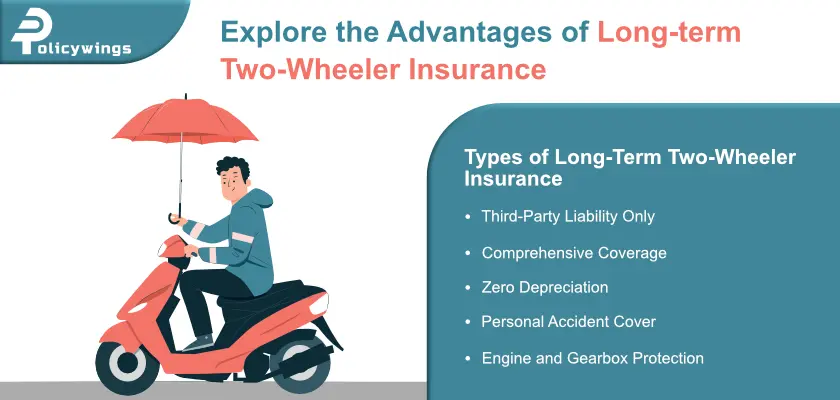
After discussing the basics, let us take a closer look at some important points about two wheeler bike insurance in India. There are two main coverage options available in long-term policies, just like with regular policies:
Third-Party Liability Only: This is mandatory by law, as per the Motor Vehicle Act 1988. This insurance pays for any harm you cause to another person’s car, property, or person in an accident for which you are at fault.
Comprehensive Coverage: This provides more comprehensive protection, covering not only third-party liability but also damage or theft of your two-wheeler. You can further customize your comprehensive policy with add-on covers like:
Zero Depreciation: Protects you from depreciation deductions on your vehicle’s value during claim settlement. 
Personal Accident Cover: Provides financial assistance in case of injury or death due to an accident. Engine and Gearbox Protection: Covers specific repairs to these crucial components.

Comprehensive And Third-party Liability Insurance Comparison

Comprehensive Bike Insurance

Third-party Bike Insurance

Covers losses caused by the bike and third party. It includes any loss due to theft, fire, or man-made disasters. The premium amount is usually on the higher side, as it provides comprehensive coverage. Extends the motor insurance policy with add-on coverage like engine protection, roadside assistance, and zero depreciation.

Covers any loss that occurred due to damage to third-party property. The premium amount is lower compared to the comprehensive one. Provides add-on coverage for personal accidents.

So, you have the option of choosing long-term two-wheeler insurance in both the comprehensive and third-party insurance plans.

Important Features of a Long-term Two-Wheeler Insurance Policy

Some of the important features of a long-term two-wheeler insurance policy are:

  • The policy tenure of three to five years is the most common option.
  • Similar to standard policies, you can choose between third-party liability only (mandatory) and comprehensive coverage (including damage to your vehicle).
  • Policy renewal frequency, once in every 3 or 5 year
  • No premium increases for three years for bike insurance

More Reasons to Buy Long-term Two-Wheeler Insurance?

So, the pros of having long-term two-wheeler insurance are Convenience: No need to hassle with yearly renewals. Potentially Lower Cost: Premiums may be discounted compared to buying one-year policies consecutively. This is so that you are protected from any future premium increases since the premium is set for the duration of the policy. No Claim Bonus Benefits: Compared to typical one-year policies, some insurers offer longer-term policies with better No Claim Bonus (NCB) discounts. NCB is a discount you receive on your premium for every claim-free year. Assured Coverage: Peace of mind knowing your two-wheeler is protected for a longer period.

To Sum Up,

Long-term two-wheeler insurance offers a convenient and potentially cost-effective way to protect your motorcycle or scooter. However, while purchasing two-wheeler insurance, consider your two-wheeler’s value, riding habits, and risk tolerance when selecting coverage. This is because, a brand-new motorcycle might benefit more from comprehensive coverage with add-ons, while an older scooter might be well-served by third parties only in a long-term policy.Nevertheless, if you have more queries regarding two-wheeler insurance, reach out to our team, and they will guide you through all the points.

FAQs

What is long-term two-wheeler insurance?

The two-wheeler insurance is a policy that provides coverage for your motorcycle or scooter for an extended duration, typically spanning multiple years, such as three or five years. It’s very convenient compared to others as it eliminates the need for annual renewals and also allows cost savings compared to renewing annually.

How does long-term two-wheeler insurance differ from regular insurance?

So, the two wheeler bike insurance primarily differs from regular insurance on the basis of the duration of their coverage and the frequency of renewals. So, regular insurance offers coverage for only one year, while long-term insurance offers coverage for multiple years, like three to five years.

What are the benefits of opting for long-term two-wheeler insurance?

Opting for two-wheeler insurance offers benefits like:

  • Convenience
  • Continuous coverage
  • Long-term savings
  • Protection against premium hikes

Can you explain the coverage offered under long-term two-wheeler insurance?

The bike insurance gives coverage for several risks, such as accidental damages, theft, or third-party liabilities, for an extended duration.

How long does a long-term two-wheeler insurance policy last?

A long-term bike insurance policy provides coverage for multiple years, mostly, three to five years.

Share this article:

More on Motor Insurance

Hand-picked reads on motor insurance to help you decide with confidence.

Bumper to Bumper Insurance After 5 Years in India: Is It Worth It?Car Insurance

Bumper to Bumper Insurance After 5 Years in India: Is It Worth It?

Introduction Buying car insurance is no longer just about ticking the “third party” box. Many owners today evaluate addons such as bumper to bumper (commonly called “zero depreciation”) to reduce out of pocket repair costs. But what happens once your car crosses the 5 year mark? This article explains zero depreciation insurance eligibility in India, what IRDAI endorsed wordings say and whether bumper to bumper insurance after 5 years is a smart buy, specifically for Policywings readers who want clear, practical guidance. What “bumper to bumper”/zero depreciation actually covers Bumper to bumper and zero depreciation addons are designed to eliminate the depreciation deduction applied during claim settlement for replaced parts, especially plastic, rubber and fibre components that wear out fast. In plain terms: if you have the add-on and your claim is admissible, the insurer pays the part replacement cost without deducting the normal depreciation. This improves claim value but increases your premium at renewal. Age limits and regulatory wording you should know There is no single nationwide rule that every insurer follows; eligibility depends on insurer product rules and the specific addon wording. However, many major insurers cap zero depreciation eligibility to the earlier years of the car’s life (typically up to 5 years). At the same time, IRDAI endorsed endorsement wordings used by public insurers sometimes specify different age slabs for example, a nil depreciation endorsement used by Oriental Insurance states cover is available for vehicles whose age is less than or equal to 6.5 years on policy inception and limits certain claims to the first two partial loss claims in a policy year. That demonstrates insurer discretion and differing product design. Is bumper to bumper available after 5 years in India? Short answer: sometimes. Most insurers stop offering traditional zero depreciation addons once a car is older than 5 years, but some insurers extend similar covers to older vehicles with conditions (higher premium, limited claim count or capped parts). A few market players advertise options up to 7 or even 10 years for “bumper to bumper” type covers, but those products are rarer and usually more expensive. Always confirm the exact eligibility at renewal, because availability varies by insurer and by the addon wording. Recent regulatory or compliance notes (what changed and what matters) IRDAI continues to standardize endorsements and expects insurers to disclose addon limits, age slabs and exclusions clearly at the point of sale and renewal. The Oriental Insurance nil depreciation endorsement is an example of a standardized wording that spells out age calculation, claim limits and exclusions, a useful template that other insurers echo. Also remember third party liability insurance remains legally mandatory under the Motor Vehicles Act; addons are voluntary enhancements to your comprehensive cover, not substitutes for statutory protection. Practical checklist: should you buy bumper to bumper after 5 years? Consider your car’s IDV (insured declared value). If the IDV is already low, a higher premium for zero dep may not give proportional benefit. Evaluate typical claim cost. If most past claims on your model involve plastic/fibre parts (bumper, headlights, trims), zero dep can save materially. Check limits: some policies restrict zero dep to the first one or two partial loss claims per year, read the renew offer carefully. Compare alternative addons: glass cover, engine protection and consumables cover may be cheaper and address the exact exposures you face. Factor in No Claim Bonus (NCB) and deductibles, a frequent small claim could erode NCB benefits and make the addon less attractive. When it’s usually worth it Bumper to bumper is cost effective when: the car is driven in high risk environments (city traffic, rough roads), replacement parts for your model are expensive and you value cashflow certainty for repairs. For cars with higher cosmetic replacement costs (modern plastic bumper assemblies, advanced headlamp units), the addon often pays back quickly in a single mid sized claim. When to skip it If your vehicle’s IDV is low, you drive sparingly, repairs are usually minor or your budget prioritises keeping premiums down, skip the addon or look for targeted covers (glass/engine/consumables) instead. After 5 years, many owners find targeted riders offer a better premium to benefit ratio. How to shop at renewal Ask insurers explicitly about “bumper to bumper insurance after 5 years India” options and get the precise endorsement wording. Compare at least 3 proposals for premium, claim limits and exclusions. Confirm whether mid term inclusion is allowed (many endorsements prohibit mid term additions). Keep record of prior claims and NCB, they affect pricing. Conclusion Bumper to bumper (zero depreciation) after 5 years can be available but is not universally offered; when it is, it often comes with stricter terms and higher cost. The decision should be pragmatic: weigh IDV, typical repair costs for your car model, claim frequency and the exact addon wording at renewal. For many 5+ year cars, targeted addons deliver more value than a blanket zero dep but if you drive in risky conditions and parts are costly, a carefully chosen bumper to bumper option may still be worth the premium. Always read the endorsement wording before you buy.

Written byRahul NarangPublished onNovember 26, 2025

You may also like: Claims & Support

Related guides from our claims & support desk.

Mediclaim Policy Renewal: What You Must Check Before RenewingClaim

Mediclaim Policy Renewal: What You Must Check Before Renewing

Introduction It might have happened to you or somebody you know that for years you had your mediclaim insurance policy and you were also paying regular premiums. Once time you made a claim and found out that certain benefits had lapsed. So frustrating, isn’t it? This is why it’s highly recommended that when you renew your mediclaim insurance, you must also make sure your coverage will continue to fit your needs. It’s super important to review your policy at the time of renewal, especially because medical costs are increasing. Let’s discuss what all do you need to check before renewing your mediclaim insurance in India so that you don’t miss changes in coverage or lose important benefits. What Makes Renewal So Important? Life is never the same. Sometimes situations change, sometimes lifestyle. You could develop a new illness, there could be an increase in medical prices or maybe the needs of your family grow than before. You must never renew your policy without reviewing it. When you pay attention at that time, you ensure having the right coverage when you actually need it. You can’t do much once you have bought the policy but renewals offer you a chance to: Upgrade coverage and match it with the rising medical costs. Add new riders or benefits to the policy that were not there before. Always renew on time so that waiting periods don’t restart. Protect your coverage by staying regular with your payments. After all, a careful renewal is a guarantee that your mediclaim insurance policy grows with your changing needs. What to Check Before Renewing Your Mediclaim Policy? Renewing your mediclaim insurance policy doesn’t just mean paying the premium on time but ensuring your coverage is enough for you when required. Let’s see what you should definitely check at the time of policy renewal: Coverage Amount (Sum Insured) In India, medical costs are rising every year and this is a point of concern. The insured amount you chose a few years ago is most possibly not enough today, especially if you’re in a metro city. Check if you need to increase the coverage while you are renewing. Waiting Periods for Pre-Existing Diseases When you keep renewing the policy, the waiting period for pre-existing conditions also keeps reducing and it’s a big benefit. At the time of payment, confirm whether the mediclaim insurance policy cover those diseases now. Room Rent Limit and Hospital Network Room rent limits or hospital tie-ups might be small factors but can affect your claim big time. If you want a private room but your policy allows only a shared room, you may have to pay yourself. It should also be checked if your preferred hospitals are a part of the insurer’s network. New Riders or Add-On Benefits Many insurers introduce new features for the convenience and benefits of the policyholders. People can always opt for the extras like critical illness riders, maternity cover etc. Of course, renewal time is the best to add these riders to your mediclaim insurance. Premium vs. Benefits The premium you’re paying should ideally justify the benefits you’re getting. It’s possible that there’s another plan from the same insurer or a different one that offers better coverage at a similar cost. At renewal, you upgrade your policy and it continues the same. No-Claim Bonus (NCB) Your insurer should also offer a no-claim bonus. Basically, many insurance companies increase your coverage amount for the year you don’t make a claim. Do keep this benefit in mind while renewing. Exclusions and Policy Updates Insurance companies also keep updating their terms. Every time you renew, go through the fine print to check what’s not included this year. It could be procedures like cosmetic surgeries or certain advanced treatments, so stay alert and informed. Grace Period for Renewal Renewal of mediclaim insurance in India has to be done before the due date. While insurance companies normally provide a grace period of 15–30 days for payments, you can’t make claims during this period. Also, missed renewal means waiting periods would restart and all the previous time has been wasted. Mistakes People Make During Renewal Renewing a mediclaim insurance policy isn’t limited to continuing the same plan. There are mistakes that so many people unknowingly make that either affect their coverage or claims. Just beware of these catches for a wise renewal: Not updating health details– Don’t forget to inform your insurer if you’ve developed a new illness or undergone surgery because hiding details can lead to your claim being rejected. Missing the due date– A late renewal means you will missout on your No Claim Bonus (NCB) and even a policy lapse. Ignoring changes in coverage– Sometimes insurance company change their terms, add new rider options or modify coverage so go through the fine print. Accepting higher premiums blindly– Many people pick up the first policy they see. Not comparing alternatives, they end up paying more. How to Save on Your Mediclaim Insurance? Time for renewal? It’s the perfect chance to make your mediclaim insurance in India more cost-effective while holding on to the benefits. All you need is a little planning for a reduced premium and improved coverage. Consider portability– If you find that another insurer is offering better benefits at the same cost, you can switch to it. Your continuity benefits will remain the same. Opt for long-term policies– Many insurers will also offer you discounts if you straightaway buy a 2–3 year mediclaim policy instead of renewing it every year. Adjust deductibles wisely– If your employer already provides health cover, choose a bigger deductible on your mediclaim to lower your premium. Compare online before renewal– You can also benefit from the market competition. You must check different plans so you can get the best value for your money. The Rising Need for Mediclaim Insurance in India The costs of healthcare in India are skyrocketing and there are hardly any signs of slowing down. Treatments for critical conditions like cancer,

Written byRahul NarangPublished onOctober 30, 2025
Claims Advocacy in India: How Insurance Brokers Improve Settlement OutcomesClaim

Claims Advocacy in India: How Insurance Brokers Improve Settlement Outcomes

Introduction The year 2025 saw the Indian insurance policyholders being more aware about their rights than ever before. However, they still find the claims processes difficult to go through. The consumers are frequently feeling disgruntled because of complicated paperwork, waiting for long periods and having disagreements with their coverage, to name a few. In India claims advocacy has evolved as an essential support system with brokers making sure fair treatment and timely settlements for policyholders. The function of brokers has shifted from merely policy placement to a more supervisory role in the safeguarding of policyholder’s rights during claims, which is the most difficult phase of the insurance journey. The Role of Brokers in Claims Advocacy Insurance brokers are the middlemen between the people who own the policies and the companies that provide the policies. In the claims setting, their work is not only on the side of the administration. Brokers assist to do the following tasks: they interpret policy terms, they execute the required paperwork, they negotiate with the insurance companies and they even provide legal assistance if there is a conflict. By advocating for policyholders brokers make sure that the insurers honor the coverage promised in contracts with reducing the risk of delays or unfair rejections. By combining the technical aspects of the insurance industry with the role of advocator, brokers have become an important factor for the trust in the system. Challenges in Claims Settlement Despite regulatory reforms, claim settlement remains an area of friction in India. The common issues that frequently occur are: Ambiguity in Policy Terms: Disputes are usually the result of vague exclusions or unclear definitions of the terms. Delays in Processing: Inadequate documentation and procedural inefficiencies are the main reasons that settlements can be delayed. Claim Denials: Insurers may refuse claims because the policyholder did not disclose all the facts, informed the insurer late or on technical grounds. Under settlement: When claims are only partially paid leaving losses uncovered then the total amount of loss causes dissatisfaction and filing of lawsuits. These issues have led to a number of court decisions which have emphasized that insurer’s contracts should be interpreted in a manner that is fair and favorable to the insured, especially when the language is unclear. Legal and Regulatory Framework In the Indian insurance industry, the Insurance Regulatory and Development Authority of India (IRDAI) is the monitoring body that keeps the insurance companies within certain time limits for their claim settlement and requires them to indicate the reasons explicitly in case of a denial. As licensed intermediaries, brokers have the duty to work in the interest of their clients and to ensure that these requirements are fully complied with. The courts through the Consumer Protection Act have in their judgments always placed the liability on the insurer in such cases where the claim has been rejected in an arbitrary way and without any justification. There are numerous instances where the courts have not only ordered the complete settlement of the claim but also have awarded the complainant money for the inflicted mental agony and the litigation costs. The active participation of brokers diminishes to the lowest amount the possibility of conflicts that become legal by providing the on time execution, accurate documentation and fair negotiation. Moreover, affected by the introduction of the Digital Personal Data Protection Act, 2023, intermediaries dealing with sensitive claim data must maintain confidentiality on a high level. Violations or data breaches in the claims management process may not only lead to the issuing of fines but also to damage the organization’s reputation. Benefits of Insurance Claims Advocacy Fair Settlements: Brokers represent the rights of the insured and ensure that the claims are not rejections which are false or under settlements. Expert Guidance: Brokers assist clients in understanding policy wording thus they can communicate better and the claim application becomes stronger. Reduced Legal Risk: With professional support, policyholders are less likely to face prolonged litigation. Faster Resolutions: Coordinated communication between brokers and insurers minimises delays in claim settlement. Consumer Protection: Brokers’ accountability under law ensures policyholders have an additional layer of support against insurer misconduct. Brokers as Risk Managers Beyond claims handling, brokers also assist businesses and individuals in adopting preventive measures to minimise claim disputes. The list can even go to helping a client disclose the true facts of the situation, maintaining the risk management system that helps the company and keeping detailed records. Being proactive will give you the benefits of a smooth claim and that you will comply with the requirements of the policy. Claims advocacy is also a good thing for negotiations with big settlements covering property, liabilities or health where conflict can reach millions of dollars as these are corporate clients. The knowledge of a broker through the documentation process and abiding by the regulatory requirements is what makes the difference between winning and losing cases. Upcoming of Claims Advocacy in India As the insurance part enfolds digitisation and the part of brokers in claims advocacy is also developing: AI Driven Claims Help: Data tools support brokers identify lost documents and flag discrepancies early which reduces rejections. Digital Ledger Records: Established digital records of claims build up transparency and accountability. Fusion Models: While digital structure gets better efficiency, brokers can personally guide and it remains important in complicated cases. Insurance claims advocates in India are going to be in greater demand as the urban risks keep on increasing, climate related claims and regulatory scrutiny. Brokers will keep playing the role of interpreters between the insurers who are bound by contracts and policyholders who have been expecting a fair settlement. They will thus make a key contribution to the achievement of such settlements. Conclusion In the constantly changing environment of 2025 it has become crucial that the broker claims support be present for the proper and fair settlement of claims. Insurance brokers take on the roles of champions, mediators and compliance monitors, thereby facilitating rightful payouts to the insured. Claims assistance in India is empowered

Written byRahul NarangPublished onSeptember 11, 2025

Explore: Business Insurance

Broaden your view with a quick read on business insurance.

Commercial Property Insurance Growth in India: Managing Urban RisksCommercial Property Insurance

Commercial Property Insurance Growth in India: Managing Urban Risks

Introduction With India urbanizing so quickly, the insurance landscape particularly in the commercial sector has undergone a major change. With cities expanding, real estate development is rising and businesses increasingly exposed to natural and man made disasters are driving record demand for commercial property insurance which is reaching unmatched levels. This part of insurance has shifted far behind just asset protection and has become an important part of risk management for enterprises navigating today’s urban challenges. Rising Demand for Business Property Coverage As India’s business centers grow, the chance of damage from fire, floods, earthquakes, theft and cyber attacks increases. The rise in climate related events has made city properties more at risk. Because of this the business property insurance is now needed for all businesses from small stores to big factories. A big change is that there are more businesses that are buying policies that cover not only buildings but also equipment, stock and business interruption. This complete approach shows that companies understand that the business disruptions can cause bigger financial losses than the cost of fixing physical damage. Regulatory Oversight and Policyholder Protection The Insurance Regulatory and Development Authority of India (IRDAI) guides India’s insurance rules. These rules emphasize clear information, fair pricing and quick claim settlements. Policies have to follow strict rules about what they cover to avoid arguments. For cities facing high risks there is an additional cover option such as earthquake or terrorism protection which are commonly advised. Recent court cases show the legal issues that can come up in business insurance disputes. In some cases before consumer commissions and High Courts the insurers had to pay claims because they rejected them using unclear exclusions or not fully explaining the policy. Courts have said many times that insurance contracts must be handled with honesty and that insurers should interpret policies in a way that benefits the policyholders. This legal trend makes it easier for businesses to get compensation and makes insurers more responsible for handling claims quickly and honestly. Urban Risks Driving Policy Growth India’s urban centers face a wide spectrum of risks and insurance adoption is rising accordingly: Natural Disasters like Flooding in metro regions and seismic risks in northern and northeastern states demand specialised coverage. Densely packed industrial and commercial areas have more fire risks so fire riders are important. Because property crimes are up in cities there is a greater need for protection of inventory and buildings. Since businesses rely on being open all the time then even brief shutdowns can lead to big losses which makes business interruption coverage very important. Urban businesses are realizing property insurance is a necessity rather than just an option because of the risks involved. Digital Change in Commercial Property Insurance Commercial property insurance in India has changed because of digital platforms and AI based risk assessment. Tools can now check how strong buildings are and also location based risks even the weather patterns so insurers can set policy prices better. For those with policies the digital claim systems cut down on paperwork and speed up payments. Also devices like fire sensors and security systems are being added to insurance plans. Companies that use these tools to lower risks often get lower premiums which encourages them to take safety steps. Legal Consequences and Responsibilities Business insurance regulations have a few important responsibilities for insurers and policyholders: Insurers: If an insurer mistakenly denies a claim they may face penalties under consumer protection laws. Courts may also order compensation for emotional distress and legal fees on top of requiring the claim to be paid. Policyholders: If a policyholder does not disclose all important information like previous damage or poor safety procedures, their claims may be rejected and they could face legal action. It is critical to be honest and meet all policy demands. Duty of Good Faith: Courts have confirmed that both sides of an insurance deal have to act honestly and if they don’t then they can be sued and lose money. Strategic Considerations for Businesses Businesses in cities should do risk assessments that look at both building risks and location related risks when picking insurance. Think about using extra coverage options: Things like coverage for natural disasters, theft and business problems can add important protection in cities. Follow the law and be honest when you apply and follow safety rules you can avoid problems with claims and get better insurance options. Use of technology: Prevent problems like fire systems as they have security cameras and they keep monitoring tech which can lower risks and also even lower your insurance costs. Keep up with legal news: Knowing about court decisions can help you be ready for possible legal arguments. Conclusion Commercial property insurance in India has evolved because of the digital platforms and AI based risk assessment. By 2025 the business property insurance will be an important part of how companies in India deal with the risks of fast-growing cities. The higher need for this kind of insurance shows that risks are increasing and that people know more about how insurance can protect them financially. Because rule makers want things to be clear, courts are protecting the rights of people with insurance and technology is making coverage smarter. Property insurance is becoming a main part of keeping businesses going. For businesses it’s vital to pick complete policies, follow the rules and take steps to prevent problems in cities.

Written bySagar NarangPublished onOctober 3, 2025
Annual Insurance Checklist for Indian Businesses: A Strategic Business Insurance ReviewBusiness Insurance

Annual Insurance Checklist for Indian Businesses: A Strategic Business Insurance Review

Introduction Annual insurance checklist is not just a year end formality, it is the most important step in regulating an in-depth business insurance review. Businesses have to make sure that their insurance portfolio stays operationally as well as functionality to be relevant, financially sound and compliant with the law in India’s complicated regulatory and business environment. An annual review aids in finding gaps, updating coverage to reflect expansion and bringing policies into line with evolving market conditions, industry standards and legal requirements. Why does Annual Insurance Reviews Matter in India? Legal basis for insurance contracts is established by the Insurance Act of 1938 and created by the Insurance Regulatory and Development Authority of India (IRDAI) Rules. Compliance by itself, though, does not ensure sufficient protection. Business risks change as a result of supply chain modifications, new technology deployments and territorial expansion. Inadequate indemnity or claims denial may result from failing to modify insurance coverage appropriately. Indian courts have stated again and again that it is the responsibility of businesses to ensure correct and accurate policy declarations and appropriate sums insured which are particular in cases like United India Insurance Co. Ltd. v. Pushpalaya Printers. As a governance tool, an annual checklist makes sure these regulations/obligations are fulfilled. Step 1: Review All Current Policies Gathering all of your current policies, property, liability, cyber, marine, directors & officers (D&O), professional indemnity, employee benefits and any specialised industry coverage is the first step in your yearly insurance checklist. Examine each policy’s endorsements, exclusions, limitations and declarations in relation to how your company currently operates. For example, the amount insured for liability or business disruption coverage which might not be sufficient your revenue can increase significantly. According to the “average clause” found in many policies, underinsurance is a frequent cause of partial claim settlements in India. Step 2: Verify the Compliance with IRDAI and other Legal Regulations From legal frameworks such as the IRDAI (Protection of Policyholder’s Interests) Regulations, IRDAI requires fair claims settlement procedures and transparent disclosure. Your business insurance review should verify that your policy structure complies with any industry specific statutory requirements and that your insurer is compliant. For instance, certain industries such as the manufacturing of hazardous materials or transportation are required by law to carry third party liability insurance. There may be fines and legal repercussions for not maintaining these statutory coverages. Step 3: New Emerging Risks The landscape of business risk changes annually. Because of India’s growing digitisation, cyber insurance is becoming essential, especially in light of the Information Technology Act of 2000’s increased regulatory scrutiny and the rise in data breach incidents. In a similar way, property and liability exposures may have changed your business and embraced hybrid working models. That’s why an annual checklist should assess the need for new coverage types, like intellectual property (IP) protection, environmental liability or supply chain disruption insurance. Step 4: Reassess Policy Limits and Deductibles Verifying that limits and deductibles are still appropriate is one of the most often neglected items on an annual insurance checklist. The coverage from the previous year may soon become insufficient due to inflation, currency fluctuations and rising litigation costs. Regardless of the actual loss, Indian courts have maintained the insurer’s authority to reject claims for amounts over policy limits. Your limits should therefore update to reflect any expansions, equipment upgrades or higher value contracts you have taken on. Step 5: Review Claims History and Insurer Performance A review of business insurance covers more than just coverage; it also evaluates the level of service provided by your insurer. Look for trends in the claims from the previous year: Did there have to be any delays? Were settlements equitable? Did disagreements arise because of exclusions? Although the IRDAI still has complaint redressal procedures in place, proactive review assists you in moving to insurers with superior claim handling records before problems get out of hand. Step 6: Align Coverage with Contractual and Lender Requirements Certain insurance obligations are imposed by many contracts, especially those with clients, vendors, or financial institutions. These could be named insured clauses, subrogation waiver clauses, or minimum liability limits. During your annual review, ensure that your policies meet these obligations. Even in the absence of a loss, noncompliance may result in financial penalties and contract violations. Step 7: Update Beneficiaries and Named Insureds Over time, key personnel, partnerships and business ownership structures may change. The beneficiaries, additional insureds and named insureds must all be updated, according to an annual checklist. This guarantees that payouts reach the right people and prevents disputes at claim time. Step 8: Record the Review for Audit and Governance Objectives It is a good governance practice to keep a written record of your annual insurance checklist and review procedure. It shows regulators, auditors and stakeholders that due diligence has been done. Additionally, documentation can be used as a point of reference when negotiating insurance renewals or changing providers. Legal Principles Supporting Regular Reviews The idea that insurance contracts are founded on the highest good faith requiring the insured to accurately disclose material facts is continuously upheld by Indian case law. The Supreme Court emphasised in Satwant Kaur Sandhu v. New India Assurance Co. Ltd. that a policy may be nullified due to misrepresentation or non disclosure. By making sure that all modifications to operations, assets and liabilities are fully disclosed prior to renewal, an annual review helps to reduce these risks. Conclusion Insurance is turned from a passive expense into an active business tool with the help of a well organised annual insurance checklist. It improves claim defensibility, reduces gaps, maximises costs and guarantees legal compliance. Indian companies can strengthen their resilience, appease partners and regulators and protect themselves from new risks in a market that is becoming more and more unstable by approaching the business insurance review as a governance exercise rather than an administrative task.

Written byRahul NarangPublished onSeptember 3, 2025
Cyber Insurance in India 2025: Essential Trends for SMEs & StartupsCyber Insurance

Cyber Insurance in India 2025: Essential Trends for SMEs & Startups

Introduction India’s quick digital adoption has accelerated growth with exposed businesses to increasing cyber risks like data breaches, data theft, ransomware and phishing attacks. For Small and Medium Enterprises (SMEs) and startups the financial effect of such incidents can be serious. Till 2025, cyber insurance in India is reaching momentum which is driven by stronger regulations and increasing cyberattacks with growing awareness of risk management. This article underlines the essential trends in SME cyber liability insurance and how smaller enterprises can get ready for the futu233re. Growth of Cyber Insurance in India Before a few years cyber insurance in India was viewed as an irrelevant cost. This varied after major breaches in banking, IT and e-commerce as they were prone to high shares of cyberattacks. Controllers like RBI and IRDAI shoving for stronger defenses, adoption has increased. By 2025, SMEs and startups increasingly view SME cyber liability insurance as essential as they protect against legal costs, fines, reputational damage and recovery expenses. Why Cyber Insurance is Essential for SMEs and Startups? SMEs and startups, mostly prioritise speed rather than strong cybersecurity which leaves them endangered due to the limited budgets and dense reliance on digital tools and customer data. One breach can cause damaging financial and reputational damage. Cyber insurance has evolved to be crucial with insurers offering customised and affordable policies to maintain business continuity. Essential Trends Operating Cyber Insurance Adoption in 2025 Developing Refinement of Cyber Threats: Cybercriminals are advanced tools as leverages which includes AI driven phishing and deepfake technology which can be used to breach systems. Small firms are also no longer protected from these attacks that were used to be aimed at large corporations. Regulation requirements for Data Protection: With the Digital Personal Data Protection Act the businesses handling customer data, have to face stronger compliance requirements. Penalties for non compliance can be serious. Advancement in Sector Explicit Policies: Insurers have made the move beyond collective products to design SME cyber liability insurance that serves industries like fintech, healthtech and e-commerce. Sectors like these can handle sensitive financial or health data which makes targeted coverage important. Increasing Integration with Cybersecurity Services: Cyber insurance providers are not acting just as financial support now. They are associating with cybersecurity firms to give bundled solutions risk assessments, incident response teams and real time monitoring with insurance coverage. This integration helps SMEs recover after an incident and strengthen defenses continuously. Increasing Investor and Client Expectations: Investors and corporate partners are rapidly associating the risk management practices of startups. Having a strong cyber insurance signal maturity and reliability can influence funding decisions and client partnerships. Complexity in Cyber Insurance Adoption Besides the increase in demand there are many complications for SMEs and startups in India. Premiums are more accessible than before and can still be seen as a significant cost for primal stage companies. Furthermore, many entrepreneurs are still unclear about the main things that the policies actually cover which leads to cracks in protection. Insurers are functioning to make policy terms easy but the tangledness of cyber risks eventually makes it problematic, to provide evenness in clarity. Additional complexity is the lack of uniform underwriting systems. As cyber risk is huge and continuously developing the insurers mostly struggle to have accurate premiums. This uncertainty can make coverage less predictable for businesses although data driven underwriting practices are beginning to improve the situation. Plans for SMEs and Startups in 2025 SMEs and startups are looking to secure cyber insurance in India and the initiation is through preparation. Insurers rapidly calculate the cybersecurity structure of applicants before coverage issuance. Businesses that show proactive rates like regular vulnerability assessments, employee training and incident response planning are probable to access finer coverage at favorable premiums. Furthermore, startups should see insurance as an individual solution and a part of wider risk management planning as well. Investing in cyber hygiene practices and complying with data protection regulations with conducting regular third party audits, these all enhance protection, security and insurability. Conclusion Cybersecurity threats are increasing as they are evolving and they are not only just delusional risks because they are daily actualities for Indian businesses of all sizes. For SMEs and startups the repercussions of underestimating or minimising these risks can be vulnerable. Cyber insurance is evolving very rapidly and giving financial protection with strategic support for regulatory compliance and investor confidence. With the advancement of SME cyber liability insurance, smaller businesses in India have grown with a lot of confidence, being aware that they are much better trained to hold and recover from uncertain complex cyber attacks or incidents. In a world where digital trust is as valuable as financial capital, insurance is no longer an optional add on; it is a core element of sustainable business growth.

Written byRahul NarangPublished onOctober 13, 2025