Family Floater Health Insurance Plan: Tips & Benefits
By Rahul Narang
Family Floater Health Insurance Plan: Tips & Benefits

Homepage  > Articles >

Family Floater Health Insurance Plan: Tips & Benefits

Table of Contents

Toggle

Family Floater Health Insurance Plan: Tips & Benefits

By Rahul Narang
Family Floater Health Insurance Plan: Tips & Benefits

It goes without saying that having health insurance in the modern era is like having an umbrella protecting you from the downpour of medical bills.

But having a family floater health insurance policy shields you and your loved ones from the strong winds and rain of medical bills, much like a covered roof.

With the rising cost of insurance plans in our country, it just burdens our pockets to get health insurance for all our family members individually. 

That is why, there is a family floater health insurance that covers our entire family without putting holes in our pockets. 

Let’s understand everything in detail about a “family health insurance plan” and how it’s better than an individual health insurance plan. 

What is a Family Floater Health Insurance Plan?

Family floater health insurance is also termed a family health insurance plan.

And it’s very evident from the name itself, that a family floater  plan gives medical coverage to the entire family.

In family health insurance, a single sum insured is shared among all members. So, any member of the family can avail the insurance up to the policy’s limit.   

So, with a single-family health insurance plan, the primary policyholder can insure multiple family members under a common sum.

You are basically paying a single premium to insure yourself, your spouse, children, and parents (based on the type of plan). 

Why Is Family Floater Insurance Better Than Individual Health Insurance?

To determine which medical insurance plan is better for your family, it is essential to compare family floater health insurance with individual health insurance

So, let’s understand this with an example.

There are two friends, Mr. Singh and Mr. Yadav. They both are a family of four. However, Mr. Singh took family floater health insurance, and Mr. Yadav took an individual health insurance plan for his family.  

Now, Mr. Singh holds a floater health insurance policy worth Rs. 8 lakh. So, here, the total amount of health coverage is Rs. 8 lac for 4 members. 

Whereas, Mr. Yadav, with an individual health insurance plan, has a policy amount of Rs. 2 lakhs (for each member). So, the total amount of health coverage in his case is also Rs. 8 lac. 

Both families faced medical emergencies at the same time, and the hospitalization and treatment expenses incurred by both families were Rs. 5 lac. 

In this case, Mr. Yadav only got Rs. 2 lac after his claim was reimbursed; he was still required to pay the remaining Rs. 3 lac out of pocket.

However, in Mr. Singh’s case, the maximum policy amount was Rs. 8 lac, so he was reimbursed for Rs. 5 lac.

As a result, Mr. Singh is happy because he did not have to pay for any of the hospitalization expenses out of pocket. 

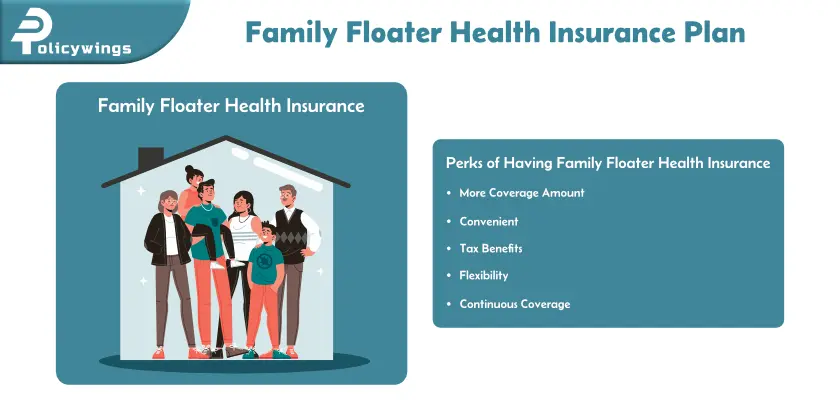
Perks of Having Family Floater Health Insurance

Some of the major benefits of having a family floater plan are:

  1. More Coverage Amount
    In family floater insurance, each family member has access to a total sum insured. So a single plan with a shared sum insured is generally cheaper than buying individual policies.
  2. Convenient
    Managing one policy for an entire family is much more convenient than handling multiple policies.
  3. Tax Benefits
    Similar to other health plans, a family floater plan also lets you avail of tax deductions on the paid insurance premium. The premium paid for a family floater plan is eligible for tax deduction under section 80D of the Income Tax Act, India.
  4. Flexibility
    A family floater plan provides flexibility by allowing you to add or remove family members whenever needed, making the insurance plan adaptable to changing family situations.
  5. Continuous Coverage
    Generally, health insurance expires on the death of the insured. However, a family health insurance plan continues to offer coverage to the family even after the demise of a particular family member. 

Tips to Choose the Right Family Floater Health Insurance Plan

Before you buy a family floater plan, it’s important to know what points to consider to get the best floater health insurance plan. 

Some of the factors, that you should consider while buying a family health insurance plan are:

  1. Family size and age
    First, decide the number of family members you need to cover and their age groups. Because younger individuals might need lower coverage as compared to older individuals
  2. Total sum insured
    Remember to choose a sum insured that covers all your potential medical expenses. For this, you can take into account some factors like rising healthcare costs and the family’s medical history.
  3. Plan Coverage
    Choose a plan that offers all-around coverage for all the hospitalization expenses, pre and post-hospitalization costs, and ambulance services.
  4. Network Hospitals
    Check if the plan offers a wide network of hospitals for cashless hospitalization facilities.
  5. Exclusions
    Review the policy wordings carefully to understand any exclusion like pre-existing conditions or specific treatment.
  6. Renewability
    Go for a family insurance plan that guarantees renewability so that you can get continuous coverage throughout your life.
  7. Claim settlement ratio
    Also, research the insurance company’s claim settlement ratio to understand their efficiency and compatibility in settling and handling claims. 

To Conclude, 

A family floater health insurance plan is a valuable protection tool that you can gift to your family. 

However, properly understand how these plans work and consider your family’s needs before choosing the right and affordable health insurance plan

You can also compare rates, but if you are short on time, just call our advisors and they will walk you through all the important points for a family floater health insurance plan.

Some Frequently Asked Questions

What is a family floater health insurance?

A family floater plan is made to cover several family members’ medical expenses under a single insured amount. Any family member can then use the insured amount to pay for their medical bills.

Which is better family floater or individual insurance policy?

Both are good health insurance plans thus, the better can only be decided based on your situation. For instance, if you have a family that depends on you for its well-being than you should choose a family floater plan. But, if you wish to get yourself insured, than go for an individual health insurance plan.

What are the advantages of a family floater health insurance policy?

The list of benefits that you can get by buying the aforementioned insurance plan are:

  • Pre-hospitalization cover
  • Ambulance cover
  • In-patient hospitalization coverage
  • Post-hospitalization cover
  • And lifelong renewability

Who Cannot be covered under a family floater policy?

The individuals like nonfamily members, siblings, relatives, and those with pre-existing medical conditions can not be included in a family floater policy. Also, there are some age restrictions regarding the children and elderly family members are applied to a family floater plan.

What is family floater travel insurance?

A family floater travel insurance policy, like a family floater  policy, is intended to protect a family traveling together against a variety of risks, such as medical emergencies, trip cancellation, misplaced luggage, and more.

{"@context":"https:\/\/schema.org","@type":"FAQPage","mainEntity":[{"@type":"Question","name":"What is a family floater health insurance?","acceptedAnswer":{"@type":"Answer","text":"

A family floater plan is made to cover several family members’ medical expenses under a single insured amount. Any family member can then use the insured amount to pay for their medical bills.<\/p>"}},{"@type":"Question","name":"Which is better family floater or individual insurance policy?","acceptedAnswer":{"@type":"Answer","text":"

Both are good health insurance plans thus, the better can only be decided based on your situation. For instance, if you have a family that depends on you for its well-being than you should choose a family floater plan. But, if you wish to get yourself insured, than go for an individual health insurance plan. <\/p>"}},{"@type":"Question","name":"What are the advantages of a family floater health insurance policy?","acceptedAnswer":{"@type":"Answer","text":"

The list of benefits that you can get by buying the aforementioned insurance plan are:<\/p>

    <li aria-level=\"1\">Pre-hospitalization cover<\/li><li aria-level=\"1\">Ambulance cover<\/li><li aria-level=\"1\">In-patient hospitalization coverage<\/li><li aria-level=\"1\">Post-hospitalization cover<\/li><li aria-level=\"1\">And lifelong renewability<\/li><\/ul>"}},{"@type":"Question","name":"Who Cannot be covered under a family floater policy?","acceptedAnswer":{"@type":"Answer","text":"

    The individuals like nonfamily members, siblings, relatives, and those with pre-existing medical conditions can not be included in a family floater policy. Also, there are some age restrictions regarding the children and elderly family members are applied to a family floater plan. <\/p>"}},{"@type":"Question","name":"What is family floater travel insurance?","acceptedAnswer":{"@type":"Answer","text":"

    A family floater travel insurance policy, like a family floater\u00a0 policy, is intended to protect a family traveling together against a variety of risks, such as medical emergencies, trip cancellation, misplaced luggage, and more.<\/p>"}}]}


Share this article:

More on Health Insurance

Hand-picked reads on health insurance to help you decide with confidence.

Is Group Personal Accident Insurance Worth It for Employees in India?Personal Accident

Is Group Personal Accident Insurance Worth It for Employees in India?

Introduction Group personal accident insurance India has become increasingly essential for employers wanting to protect their workforce against unforeseen incidents as there is a high chance of evolving risks and on site injuries where insurance has gained attention as a helpful inclusion in employee benefit packages across organizations of all sizes. Group Personal Accident Insurance Group personal accident insurance (GPAI) is a policy that covers employees altogether against accidental death, permanent disablement and temporary disablement (in many cases). Customised for a group like company staff or association members where this insurance offers financial protection when there is an unpredictable accident. In India where workplace and travel related incidents are common, GPAI provides crucial coverage to lower economic fallout. Significance of Group Coverage for Employers Cost Effective Premiums: Group schemes influence economies of scale which is better than individual accident plans. Insurers usually offer lower per person premiums under group arrangements which makes it inexpensive for employers while increasing employee security. Simplified Administration: Holding on to a single insurance policy instead of numerous individual ones simplifies HR operations. PolicyWings clients can appreciate how group personal accident insurance decreases paperwork, eases onboarding and makes claims processing quick because of systemised coordination. Moral and Competitive Corner: In a competitive job market offering accident insurance shows that an employer values employee well being. This not only increases morale but also enforces retention and attracts talent by differentiating compensation packages. Benefits of Group Coverage for Employees Financial Security after an Accident: If an unfortunate accident results in permanent disability or death then the lump sum compensation eases financial load on families. Access to Interim Income Support: Some policies include temporary total or partial disablement cover which provides income in case of an employee being incapacitated for a period. This type of benefit maintains employees and their families during recovery. Quick Claim Processes: Group policies usually have standardized claim mechanisms which are managed at the employer level which allows employees to file claims easily without navigating complicated individual procedures. What Employers Should Consider When Selecting a Plan Extent of Coverage: Group personal accident insurance has different offers. Employers must check if the policy includes death, permanent and temporary disability and sometimes, medical expenses or daily hospital cash. Wider coverage has prices slightly higher but provides comprehensive protection. Coverage Limits must be Adequate: having adequate coverage limits per employee is essential. Compensation should be relevant to local cost of living, typical wage levels and potential liabilities from accidents. Not insuring rightly could leave families inadequately supported. Inclusions and Exclusions: Policies often exclude risky activities (for example extreme sports or non work related accidents). Employers have to review the list carefully to make sure that the coverage matches employee real world risks particularly in industries like logistics, manufacturing or field services. Record of Claim Settlement: Evaluating the insurer’s reputation for claim processing in India is essential as well. A quick transparent claim experience increases employee trust in the benefit and it also reinforces its value. Add On Features: Optional riders like repatriation of remains, ambulance charges, funeral expenses or education benefits for dependents can enhance policy utility a lot. It&#8217;s optional but benefits are usually appreciated by employees. Clarifying Common Concerns One common doubt is whether GPAI overlaps with other employee insurance coverage. In India, many companies provide group health and life insurance and still those policies may not fully cover accidental disability or death arising from nonhealth related causes. Accident specific coverage adds an additional layer of protection customised for sudden and unintended events. Another doubt is whether smaller organizations can afford group personal accident insurance. Yes, they can. Many insurers provide entry level group plans that limit the amount of costs while providing essential protection and they are flexible as well. As the workforce evolves the coverage tiers can balance accordingly. Improving Your HR Benefits Package Converting group personal accident insurance into overall employee well being frameworks strengthens employer branding. When put together with group health, life and wellness offerings then GPAI is a complete trio of risk protection. This strengthens policies marketed under “employee benefit insurance”, “corporate accident policy”, or “accident insurance for employees India”. And proactively communicating these benefits during orientation and periodic HR outreach helps employees understand them which improves perceived compensation value. Advice for Maximizing ROI on GPAI Conduct a risk assessment to adjust coverage to your workplace profile Survey employee concerns around security and financial uncertainty Compare insurer quotes focusing on claim settlement ratios and coverage scope Educate employees on policy particulars especially the claims process Review policy annually to customise benefits or coverage limits as needed Conclusion Group personal accident insurance India offers a cost efficient, morale boosting and administratively effective way to add adequate protection for employees. In circumstances where accidents can ruin lives and livelihoods, this coverage plays a critical role. For employers it&#8217;s not just an expense but it&#8217;s an investment in workforce resilience and employer brand differentiation.

Written bySagar NarangPublished onNovember 19, 2025

You may also like: Life Insurance

Related guides from our life insurance desk.

How Much Term Insurance Cover Do I Really Need?Life Insurance

How Much Term Insurance Cover Do I Really Need?

Before buying term insurance, most people ask how much cover do they really need. You can’t buy a plan just because someone suggested a number like ₹50 lakh or ₹1 crore. But it’s not the same for all. The right answer depends on your income, responsibilities and future plans. A life insurance term plan is meant to replace income and protect the financial future of your family. But it can effectively do as expected only if the coverage amount is properly calculated and not guessed. This blog will make it easy for you to understand. What Term Insurance Cover Is Actually Supposed to Do Before we jump to calculating numbers, we’ll begin with understanding the purpose of term insurance. It’s a trusted life insurance plan that is NOT designed to grow wealth or generate returns for you. Its sole purpose is to provide protection. In case something happens to you, the insurance payout should be enough to help your family in: Covering regular daily living expenses Repaying loans and liabilities Funding long-term goals like education, marriage or retirement Maintaining financial stability for many years All this makes it so important to choose the right coverage amount. Practical Way to Calculate Term Insurance Coverage All families don’t need the same coverage amount. Smart financial planners use a structured approach in which they consider these key components: Requirement for Income Replacement Take your annual income and multiply it by the number of years you think family would depend on those earnings. A common benchmark is 10-15x of your annual income (depending on age and financial dependents). For example: If annual income is ₹8 lakh, the coverage range would be ₹80 lakh to ₹1.2 crore This will make sure that your family has enough funds to manage daily expenses while they are adjusting to a new reality. Outstanding Loans and Liabilities Next, add all your existing liabilities like loans (car, home or personal), credit card balances and any other long-term liabilities. If your insurance payout cannot clear these dues then your family will face the burden. For instance, if your cover requirement as per income is ₹1.2 crore and you have a ₹46 lakh home loan, your total requirement is now ₹1.66 crore. A well-calculated life insurance term plan ensures your family is not burdened with EMIs in your absence. Future Financial Goals Think about your family’s future goals when calculating. Include: Education of children Marriage expenses Retirement planning for spouse These goals can be 10-20 years apart and require significant funds. If you ignore them today, you will be underinsured. This defeats the whole purpose of having life insurance. Existing Savings and Investments At last, subtract the financial assets that your dependents can rely on: Fixed deposits Mutual funds Provident fund balance Employer-provided life cover Personal savings Once you know this amount, you can prevent getting over-insurance and your premium will stay reasonable. What you get after this adjustment is your ideal coverage amount. Why Coverage Calculation Needs Expert Guidance Online formulas can only provide you with estimates. The assistance for insurance on Policywings simplifies the process for you. You don’t have to refer to what friends, colleagues or relatives have bought when we offer personalized guidance that considers: The pattern of your income The structure of your family Your future responsibilities With us, you don’t get a random plan but coverage that actually works in real situations. Choosing the Right Policy After Calculating the Cover Once the coverage amount is clear, it becomes a lot easier to select the right plan. So, when you buy insurance online, it’s suggested to look for: Fixed premiums you will pay for the entire policy term Flexible payout options Reliable claim settlement record of the insurer Strong, optional riders for more protection With online insurance, you can achieve higher transparency and reduced costs. This is why it is ideal for modern working individuals. Coverage Needs Change Over Time Your term insurance coverage should ideally be a sign of your current life stage. If you are an unmarried professional, you may need less cover than someone who has people dependent on them. With an increase in your income and responsibilities, coverage requirements may also change. Consultation matters a lot because you get explanations instead of just numbers. It tells why you need a certain coverage amount and how to align it with your financial goals. While a one-time calculation helps, you still need periodic review to keep your life insurance term plan relevant and effective Conclusion The right answer for the coverage needs comes from careful calculation and not guesswork. Consider all the possibilities and responsibilities. After all, a properly calculated life insurance term plan will work to protect your dignity, lifestyle and future plans of your loved ones. It’s ok if you’re unsure about the number but don’t rely on assumptions. Today, there is ease to buy insurance online and the availability of expert that will get you satisfactory coverage. For accurate calculation and personalized guidance, trust insurance on Policywings. You will be guided all the way, whether buying your first policy or reassessing your existing cover.

Written bySagar NarangPublished onJanuary 22, 2026
Common Myths About Life Insurance in IndiaLife Insurance

Common Myths About Life Insurance in India

Even after being a highly important financial tool, there is still a lot of confusion, assumptions, outdated advice and second-hand opinions around life insurance. As a result, many people delay buying a policy. Not because they don’t need it, but because there are so many myths around how life insurance actually works. There may also end up being underinsured or making poor choice of policy. Let’s take up the most common misconceptions and clear the air around them. Myth 1: Life Insurance Is Needed Only After a Certain Age One of the biggest misunderstandings is that you can wait till your later years to think about life insurance. Whereas, in reality: You pay lower premiums when you start early Health checks are fewer and coverage is easier to get Securing long-term protection becomes more affordable When you start early, you can lock in these benefits at a much lower cost. Myth 2: Term Insurance and Life Insurance Are the Same There are so many people who assume that all life insurance policies work just the same. But the truth is: Life insurance can consist of both savings or investment benefits A life insurance term plan is entirely focused on providing financial protection With term insurance, you can get higher coverage at lower premiums. Other life insurance plans bring together protection and savings. Remember this difference so you have realistic expectations in your head. Myth 3: Only Those Who Have Dependents Need Life Insurance Even if there is nobody who depends on your income at present, life insurance can still be very useful. It can help in covering: Outstanding loans (like home loans) Long-term financial responsibilities Future family planning An early purchase also helps in securing better terms for the future. Myth 4: Term Insurance Gives “Nothing Back” It is commonly believed that term insurance is a waste of money because the policyholders don’t get any maturity benefits. This is what happens in actual scenario: Term insurance is designed for protection only It provides high coverage at just minimal cost The benefit is in financial security and not any returns This is why a life insurance term plan is one of the most cost-effective ways in which you can protect your family. Myth 5: Life Insurance Is Too Expensive Many people miscalculate the cost of life insurance as too high. For them, it could be really surprising to know that: Premiums for term insurance can be very affordable Coverage is less costly when purchased early Online plans reduce additional charges It’s good to compare options of insurance on PolicyWings before deciding because then you can find real value for the price. Myth 6: Buying Insurance Online Is Risky Some people still hesitate to buy insurance online because they think it as it’s unsafe or just complicated. But, Online platforms offer full transparency Policies come directly from insurance providers Both documentation and policy tracking are very easy With trusted platforms like insurance on PolicyWings, you can get a clearer process and upfront details of features, premiums and benefits of the plans. Myth 7: Employer-Provided Life Insurance Would Be Enough Often, employees assume that workplace insurance will provide sufficient coverage. It’s not the case because: Employer-provided cover usually ends with the job Coverage amounts are usually limited only You don’t control the features of the policy By getting personal life insurance, you ensure continuity and adequate protection even if the career changes. Myth 8: Claims Are Always Difficult to Settle The fear that their claim might get rejected also discourages so many from buying insurance. they don’t know that: When details are disclosed honestly, claims are always smoother If all documentation is provided, it really helps The claim processes of reputed insurance providers are streamlined Just be thorough with the T&C of the policy and maintain transparency to reduce complications. Myth 9: Life Insurance Is About Death Benefits Only While protection is at the core of it, many life insurance policies also support: Long-term financial planning Savings according to your goals Planned payouts The key is to select the right plan that aligns with your objective and not just assumptions. Why is it Important to Clear These Myths When you believe these myths over facts, it can often lead to: Delayed financial planning Getting insufficient coverage Costly decisions in the later years of life Life insurance will work best for you when it is properly understood and not rushed or avoided. Only when you understand your needs and multiple compare plans you can choose the right policy. There are trusted platforms that clearly explain policy features and help you buy insurance online. Further, exploring insurance on PolicyWings can be very helpful. Conclusion All these myths we discussed around life insurance usually come from a lack of clarity. Looking for a reliable life insurance term plan or a policy that can also give savings benefits? It has to be in line with your financial goals and responsibilities. Learn, don&#8217;t assume. For help in choosing the best protection for you, refer to experts like PolicyWings.

Written bySagar NarangPublished onJanuary 7, 2026

Explore: Claims & Support

Broaden your view with a quick read on claims & support.

WFYP Full Form in Insurance: Meaning, Benefits and How It WorksClaim

WFYP Full Form in Insurance: Meaning, Benefits and How It Works

Introduction Upon buying insurance, you will notice different short forms in your policy documents that might confuse you. One of them is WFYP. It&#8217;s very commonly found in papers after the renewal of insurance premium for car or when you check the status of your health insurance premium payment. This short code often confuses people but it&#8217;s actually a very simple term to understand. Here, we will explain to you in the simplest way possible so that you know what you are agreeing to when buying a policy or learning your policy status. What Is WFYP Full Form in Insurance? So, WFYP is the short form for “Waiting For Your Premium.” This term in insurance is mainly used by insurance companies when your policy has been generated but the premium amount that you need to pay is still pending. Basically, it means that “Your policy is ready. Once you make the premium payment, we will activate it”. Your policy will not start till you make the payment. Why Does WFYP Matter? It is very important simply because the benefits of your policy will not start until the insurer receives the premium. Don&#8217;t just assume that you will be instantly protected after applying for a policy. WFYP clearly indicates that: Your application is accepted Your policy is all set and ready The company is only waiting for your premium so that your coverage can begin You can think of it like ordering food online. It will be prepared but you won’t get it without paying fir it. Why Insurers Use WFYP The real purpose behind using WFYP is used avoid confusion between the issued and an active policy because so many people make this mistake. Insurance companies use WFYP so that: Customers know that their payment is pending No claim is assumed without a premium receipt A record-based transparency is maintained Both parties know when the coverage starts When and Where You Usually See WFYP You can come across the term WFYP commonly during: Purchasing a new policy Renewing a car insurance policy Health insurance premium updates Porting to a new insurer Making changes in policy details Premium payments getting delayed It often shows up on: Policy dashboards SMS alerts Email updates App notifications Documents of proposal/issuance How WFYP Works: Step-by-Step Process Simply put, WFYP is the phase before insurance activation. Here’s how the actual WFYP process works in India: You select a plan: It could be car, health, life or any general insurance Submitting the application: Whether online or through an agent Reviewing your details: The insurer does KYC checks, run medical tests, does vehicle inspection, verifies documents etc. The policy gets approved: Your policy number is generated. Status changes to WFYP: The insurer is now waiting for your premium payment to be made. You pay the premium: Whether through UPI, card, net banking or cash Policy becomes immediately active: Payment is received and now claims are valid. What Happens If You Ignore a WFYP Status? WFYP is a clear message that your policy is not completed yet. You should not ignore it because: You won&#8217;t be having insurance protection Claims made will be rejected Your vehicle would be uninsured and this is illegal in India Health benefits don&#8217;t start till you make the payment Your policy may be cancelled if the premium is unpaid WFYP in Car Insurance For car owners, WFYP matters more than you think. It directly affects the insurance premium for car and also your legal safety. If your car insurance shows WFYP, it should be cleared immediately because otherwise: You can&#8217;t claim for any accidents or damages Third-party liability coverage won&#8217;t be active There may be fines if caught without active insurance If it&#8217;s a new car, the dealer may not release it without premium confirmation WFYP in Health Insurance Health insurance only works after the premium is paid. Thus, the health insurance premium must be cleared on time. If your policy shows WFYP, it means: Hospitalisation is not covered Cashless treatment is not allowed Waiting periods are not started Benefits for pre-existing disease are not active If overdue, renewal continuity can break Key Benefits of WFYP for Policyholders WFYP is not to be scared of; it’s actually helpful for the customers in many ways: Clear communication: With clear updates, you can instantly know where your policy stands. Prevents misunderstanding: There are no assumptions. You would know when the coverage starts and whether you are insured or not. Helps avoid claim disputes: All the details are clear before the policy gets active. Works as a reminder: Helps with timely premium payment so your policy doesn’t lapse. Tracks policy progress: You can know your policy is at which stage and can also be tracked step-by-step. How to Quickly Clear WFYP Just with a few minutes of attention, you can ensure uninterrupted protection. This is what you should do to avoid delays: Clear the premium payment immediately after the policy is approved Turn on updates (SMS/Email/WhatsApp) from your insurance company Enable auto-debit for car and health insurance, if possible Avoid waiting till the last day of the renewal Keep UPI/card details updated Keep the payment receipts with you for reference Conclusion WFYP simply means you must pay now to activate your coverage. Your insurance company has issued your policy, but your coverage starts once the premium is paid. Coming across a new term like WFYP, waiting for your premium, etc may bring multiple thoughts but aim to understand it. It will help you stay informed and you can avoid claim-related issues. If at all it feels overwhelming and you want a smoother experience, PolicyWings will guide you through the entire process. Let&#8217;s help you stay fully protected without stress.

Written bySagar NarangPublished onDecember 16, 2025
Car Insurance Claim Process in India: Step-by-Step GuideClaim

Car Insurance Claim Process in India: Step-by-Step Guide

Whether it’s a little scratch or a big accident, a car insurance claim can save time, money and a lot of unnecessary stress. Sadly, filing a car insurance claim seems like a complicated task to a lot of people. They tend to get all blank when the situation arises. When in reality, it’s just a simple process. Once you know what to do and when, you will have your vehicle back on the road faster. Here, we will discuss how to get the most benefit of your insurance and what a well-handled claim actually looks like. Step 1: First, Ensure Safety Before you get straight to thinking about insurance, just make sure that everyone is safe around you. If possible, move the car to a safe spot Switch on hazard lights If anyone is injured, call for medical help There is nothing bigger than personal safety. The ‘claim’ part should come later. Step 2: Immediately Inform the Insurance Company Once you have the situation under control, it’s time to inform your insurer. Most insurers let you contact them through a customer care helpline, mobile app or website, writing an email or simply by visiting the branch. The earlier you inform, the better your insurer can guide you and speed up the process. Step 3: File an FIR In certain situations, you need to file an FIR. It could be after: The vehicle gets stolen There has been a major accident involving injury or death There is physical or property damage to third party If there are only minor damages, insurance providers usually don’t ask for an FIR. Still, you must always confirm with your provider. Step 4: Document the Damage A claim settlement can become much smoother if you have proper documentation in place. Your insurer may ask you to: Take clear photos or videos of the damaged vehicle Provide the date, time and location details of the incident Share basic details of what exactly happened This step is where you exchange proofs that help the insurer assess the claim accurately. Step 5: Vehicle Inspection by Surveyor After you have informed your insurer about the claim, the insurance company then appoints a surveyor who will come to inspect the vehicle. Depending on the insurer and severity of the damage, inspection may either happen physically at the garage or can even be done digitally through photos/video calls. A reliable motor insurance provider will make sure that inspections are timely done because delays can slow the entire claim process. Step 6: Repair at Network Garage or Preferred Garage You now have two options for the repair work: Cashless Claim (Network Garage): You can take your car to an authorised garage to fix it. Your Insurer settles the bill directly with the garage and you only have to pay for deductibles and non-covered items. Reimbursement Claim: You make an upfront payment for the repair bill and submit invoices and documents to the insurer. For this, you will be reimbursed later. This step becomes much easier when your policy is backed by an extensive network of garages. Step 7: Claim Settlement Once all repairs are done and documents are verified, you can relax. The insurer will settle the claim. The final amount depends on the coverage amount of the policy, deductibles and depreciation. If you have bumper to bumper insurance, depreciation is not a stress. An honest insurer will clearly explain if there will be any deductions. This really builds trust in the process. Step 8: Delivery of Vehicle After the settlement is done, the garage releases your vehicle and you can thoroughly inspect the repairs before taking your vehicle home. This is the stage when your claim is considered closed. How Add-Ons Affect the Claim Experience Add-ons are often very helpful and make your policy stronger. They can really make the claim process smoother for you. Let’s take examples: Zero depreciation (bumper to bumper insurance): Reduces depreciation deduction on parts Roadside assistance: Helps a lot during claims related to breakdowns Similarly, there are other add-ons. While they lightly increase premiums, they also simplify the claim experience. Common Reasons Why Claims Get Delayed or Rejected Here is the most important part. Some people complain that their claim wasn’t settled or that there have been issues. But this is because they made these mistakes: They were late for claim intimation Their documents were incorrect or incomplete Driving under the influence (eg. Alcohol) Policy had expired at the time of the incident A policy alone won’t solve things for you. While filing a claim, make sure you follow the right process whether you have the cheapest insurance for car or an expensive one. Why Claim Support Matters More Than Premium Premium is surely an important part of buying car insurance. However, the real test of a policy is during a claim. When claim support is strong, it means: Claim intimation is very easy Inspections are done faster Clear communication at each step Settlements are done on time Conclusion In India, the car insurance claim process is pretty structured. But your experience will largely depend on how informed you are about the process and how supportive your insurance provider. Keep in mind all the discussed steps because they will put you in control. Whenever something unexpected happens, you know what to do next. At the end, good car insurance not only protects your vehicle but also supports you in need.

Written bySagar NarangPublished onJanuary 23, 2026