Why Should We Buy Annual Multi trip Insurance?
By Sagar Narang
Why Should We Buy Annual Multi trip Insurance?

Homepage  > Articles >

Why Should We Buy Annual Multi trip Insurance?

Table of Contents

Toggle

Why Should We Buy Annual Multi trip Insurance?

By Sagar Narang
Why Should We Buy Annual Multi trip Insurance?

If you’re getting insurance for your car, your pets, your health, and your home, then why not annual multi trip travel insurance?

With multi-trip insurance, you can save both time and money and travel worry-free. 

So, if you love to travel or your job requires frequent traveling, then this is the blog that you should read, till the end to understand everything about multi-trip travel insurance. 

Even the best-planned trip can be ruined by a flight delay or cancellation, baggage loss, or an accident.

And insurance is made to help you in uncertain times. 

Let’s understand how multi-trip travel insurance is beneficial for you. 

About Annual Multi-trip Insurance

An multi-trip insurance is travel insurance that covers more than one trip in a year. It is considered an ideal travel insurance plan for frequent travelers who fly to different destinations either for work or leisure purposes. 

So, basically, instead of paying for travel insurance every time you go on a business trip, a single premium will cover all your trips during the policy year. 

However, there are some conditions attached to a multi-trip insurance policy. Such as, for an annual multi-trip travel insurance policy, the maximum duration for one trip can either be 30, 45, 60, or 90 days. 

(When purchasing, make sure to read the terms listed on the policy document, related to the maximum duration for one trip.)

How Multi-trip Travel Insurance Works? 

Many people, like business heads, corporate executives, and freelancers, travel to different countries frequently for seminars and business meetings. 

Thus, it becomes increasingly important for these people to plan their travel budgets, like flight tickets, hotel bookings, and emergency expenses, ahead of time. 

Moreover, it’s always better to be ready for the future in order to have some certainty and security. This is where multi-trip insurance can be of great help. 

To explain it more precisely, 

Consider having multi-trip travel insurance. Over the course of the year, you take several trips, including a weekend getaway to a nearby city with your family, and two business trips abroad.

Your multi-trip insurance policy will provide coverage for all these trips, along with emergency medical expenses and flight cancellations for each trip. 

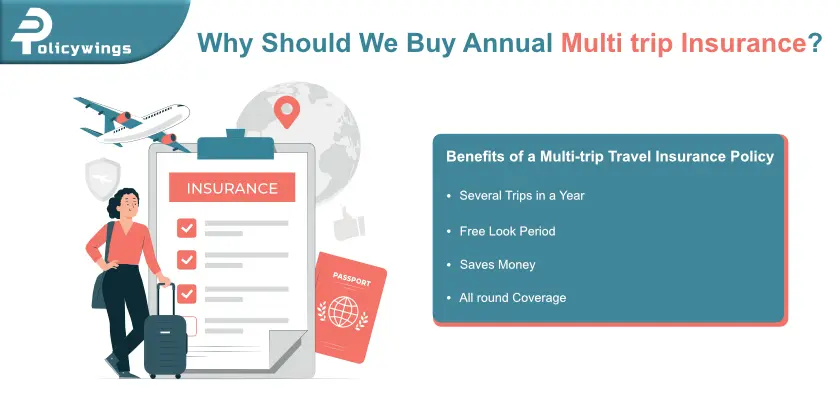
Benefits of a Multi-trip Travel Insurance Policy

Some of the benefits or we say, features of a multi-trip insurance policy are:

Several Trips in a Year

An multi-trip travel insurance gives coverage for an unlimited number of trips in a single year, with each single trip of 30-60 days duration. Therefore, it’s an economical way to cover multiple trips. 

Free Look Period

Only a multi-trip insurance plan offers a free look period. So, if you have any objections to the terms of your travel policy, you can cancel your play within the initial 15 days and get a full refund. 

Saves Money

A multi-trip insurance policy is a cost-saving option because, even if you travel three to five times a year, you would not have to pay for travel insurance three to five times. 

All round Coverage

If any medical emergency occurs, while you are on a trip, your insurance will take care of everything, from hospital expenses to evacuation. This way, you can travel worry-free.

Who Should Choose Multi-trip Insurance?

A multi-trip annual travel insurance India is a budget-friendly insurance plan for all frequent travelers. 

However, if you are still unsure about whether to purchase single-trip or multi-trip travel insurance, take a look at the categories listed below.

If you fit into any of the categories listed below, you should consider purchasing an annual travel insurance policy.

  1. If you have more than 2 trips planned in the upcoming year.
  2. If you are an impulsive traveler. 
  3. You have to travel frequently for your work or business. 

To conclude, 

If you fit into any of these categories, then annual multi-trip insurance is the right travel plan for you. 

Moreover, if you are uncertain about where to buy the insurance, then the best way here is to compare multi-trip travel insurance plans in terms of costs, features, and benefits. 

Visit PolicyWings website, to compare and get the best multi-trip insurance policy, or simply contact our team.

FAQs

What is annual multi-trip insurance?

An annual multi-trip insurance is defined as a travel insurance plan that covers multiple trips within a policy year.

Is it better to get a single trip or annual travel insurance?

Ideally, if you take more than two trips in a year then you should opt for an annual multi-trip travel insurance. Otherwise, it’s better to choose single-trip insurance.

What are the advantages of annual multi-trip insurance?

A few of the benefits of annual multi-trip insurance are- 

  • Unlimited trips a year
  • Cost-effective
  • All round coverage
  • Free look period

Share this article:

You may also like: Motor Insurance

Related guides from our motor insurance desk.

Difference Between Bumper-to-Bumper and Comprehensive Car InsuranceCar Insurance

Difference Between Bumper-to-Bumper and Comprehensive Car Insurance

Introduction You don’t buy a car insurance just fulfil a legal requirement. The repair costs have really increased, spare parts have become more expensive and road conditions can sometimes be so bad. The type of coverage you choose can actually have a big impact on your pocket. It’s common for car owners to get confused between Comprehensive Car Insurance and Bumper to Bumper Insurance. They either think that both options are the same or just not sure which one offers better value. It’s very important to understand this difference if you are on the hunt for the most effective yet cheapest insurance for car. While you get broad protection in both options, the main difference is in the way claims are settled and costs are covered. Let’s dive into the details of it. Understanding Car Insurance Before we go on to compare the two options, it’s important to understand does how car insurance generally works. So, in India, the law requires all car owners to have at least a third-party insurance policy. However, this one will pay for the damage or injury that is caused to others, not your own car or you. That highlights the need for choosing broader policies that will protect their owner’s vehicle as well. This is where car owners seek Comprehensive Insurance and Bumper-to-Bumper Insurance. They get a lot of benefits with it. What Is Comprehensive Car Insurance? It’s basically a standard policy under which you get full coverage and it also protects your car against different risks. What It Covers: Damage caused because of accidents Vehicle being stolen Fire and explosion Natural calamities Man-made disasters like riots Third-party liability (this is mandatory by law) However, there’s more to it. When a claim is made under comprehensive insurance, insurance providers deduct depreciation on the parts replaced like: Plastic components Rubber parts Fiberglass parts Tyres and batteries In simple words, it means that even though your policy is comprehensive, you will still not get 100% claim settlement. What Is Bumper-to-Bumper Insurance? This is not a separate policy but actually an add-on to comprehensive car insurance. It is also commonly known as Zero Depreciation Cover. But what makes it different is the biggest benefit that it offers. No depreciation is deduction on the replaced parts. Whether it’s plastic, rubber, or metal component, your insurer will pay the full cost of replacement (except for the consumables and deductibles). What this add-on covers: Everything that is covered under comprehensive insurance Full expenses of replacing the damaged parts A higher claim settlement value Clearly, bumper to bumper insurance is highly beneficial for new and expensive vehicles Main Differences Between Comprehensive and Bumper-to-Bumper Insurance Let’s assess both options on various factors: Depreciation Impact Comprehensive Insurance: Depreciation deduction at the time of claims Bumper-to-Bumper Insurance: No stress of depreciation deduction Claim Amount Received Comprehensive: You get partial reimbursement after deductions Bumper-to-Bumper: Almost 100% claim settlement is done Premium Cost Comprehensive: Premium is lower Bumper-to-Bumper: Premium is slightly higher but worth it Best For Comprehensive: Older cars or vehicles with low repair cost Bumper-to-Bumper: New and luxury cars, city driving Which One Is Cheaper in the Long Run? Do you think that you only need the policy with the lower premium? Actually, that’s not always the case. If you want to get the cheapest insurance for car, don’t just focus the premium amount; think beyond that. Example: The bumper of your car needs to be replaced and it will cost ₹20,000. Now, if you have a comprehensive insurance, your claim maybe reduced by ₹6,000–₹8,000 due to depreciation. But if you have bumper-to-bumper insurance, your insurer will pay almost the entire replacement amount. The upfront cost of bumper to bumper insurance is surely more but it can save you a lot during claims. This is especially helpful if repairs are frequent. When Comprehensive Car Insurance is the Best Choice? It’s may be enough to get comprehensive insurance if: Your car is over 5 years old The repair costs are usually low You drive only occasionally You don’t mind paying some part of repair costs You are looking for affordable car insurance along with basic protection For older vehicles, it often doesn’t make much sense to pay extra for bumper-to-bumper insurance. The benefits may just not be worth the higher cost. When do You Need Bumper-to-Bumper Insurance? You must definitely consider getting bumper to bumper insurance if: You have a new car or it’s less than 5 years old You live in a metro or traffic-heavy city Spare parts of your vehicle are expensive You want your claims to be stress-free You want maximum protection For new car owners, this add-on is a big relief. Often, it gives peace of mind that regular comprehensive insurance alone can’t provide. Common Myths Around Bumper-to-Bumper Insurance 1: It Covers Everything: It does NOT cover damage to engine because of water entry (unless you have an add-on), normal wear and tear or consumables like engine oil, nuts & bolts. 2: It’s Only for Luxury Cars: Even mid-range cars benefit because spare part costs are high. 3: It’s Too Expensive: The additional cost is usually small than the ultimate savings. How Claim Experience is Different Between the Two Policies Claim Aspect Comprehensive Car Insurance Bumper-to-Bumper Insurance Claim Approval Process Multiple depreciation calculations and estimate revisions are considered The approval is faster because of zero depreciation on most parts Out-of-Pocket Cost It’s higher and often unclear until all repair work is done Always lower and more predictable Interaction With Garage A lot of discussion happens around payable vs non-payable parts Negotiation with the workshop is minimal Repair Timeline Longer due to estimate adjustments might make it longer Generally quicker because settlement is simpler Claim Transparency You get the final payout amount is late in the process Better understanding of claim value from the early stage Stress Level for Owner Usually moderate to high, especially when making first-time claim Lower and more hassle-free Though both policies protect

Written bySagar NarangPublished onDecember 22, 2025

Explore: Health Insurance

Broaden your view with a quick read on health insurance.

Is Group Personal Accident Insurance Worth It for Employees in India?Personal Accident

Is Group Personal Accident Insurance Worth It for Employees in India?

Introduction Group personal accident insurance India has become increasingly essential for employers wanting to protect their workforce against unforeseen incidents as there is a high chance of evolving risks and on site injuries where insurance has gained attention as a helpful inclusion in employee benefit packages across organizations of all sizes. Group Personal Accident Insurance Group personal accident insurance (GPAI) is a policy that covers employees altogether against accidental death, permanent disablement and temporary disablement (in many cases). Customised for a group like company staff or association members where this insurance offers financial protection when there is an unpredictable accident. In India where workplace and travel related incidents are common, GPAI provides crucial coverage to lower economic fallout. Significance of Group Coverage for Employers Cost Effective Premiums: Group schemes influence economies of scale which is better than individual accident plans. Insurers usually offer lower per person premiums under group arrangements which makes it inexpensive for employers while increasing employee security. Simplified Administration: Holding on to a single insurance policy instead of numerous individual ones simplifies HR operations. PolicyWings clients can appreciate how group personal accident insurance decreases paperwork, eases onboarding and makes claims processing quick because of systemised coordination. Moral and Competitive Corner: In a competitive job market offering accident insurance shows that an employer values employee well being. This not only increases morale but also enforces retention and attracts talent by differentiating compensation packages. Benefits of Group Coverage for Employees Financial Security after an Accident: If an unfortunate accident results in permanent disability or death then the lump sum compensation eases financial load on families. Access to Interim Income Support: Some policies include temporary total or partial disablement cover which provides income in case of an employee being incapacitated for a period. This type of benefit maintains employees and their families during recovery. Quick Claim Processes: Group policies usually have standardized claim mechanisms which are managed at the employer level which allows employees to file claims easily without navigating complicated individual procedures. What Employers Should Consider When Selecting a Plan Extent of Coverage: Group personal accident insurance has different offers. Employers must check if the policy includes death, permanent and temporary disability and sometimes, medical expenses or daily hospital cash. Wider coverage has prices slightly higher but provides comprehensive protection. Coverage Limits must be Adequate: having adequate coverage limits per employee is essential. Compensation should be relevant to local cost of living, typical wage levels and potential liabilities from accidents. Not insuring rightly could leave families inadequately supported. Inclusions and Exclusions: Policies often exclude risky activities (for example extreme sports or non work related accidents). Employers have to review the list carefully to make sure that the coverage matches employee real world risks particularly in industries like logistics, manufacturing or field services. Record of Claim Settlement: Evaluating the insurer’s reputation for claim processing in India is essential as well. A quick transparent claim experience increases employee trust in the benefit and it also reinforces its value. Add On Features: Optional riders like repatriation of remains, ambulance charges, funeral expenses or education benefits for dependents can enhance policy utility a lot. It’s optional but benefits are usually appreciated by employees. Clarifying Common Concerns One common doubt is whether GPAI overlaps with other employee insurance coverage. In India, many companies provide group health and life insurance and still those policies may not fully cover accidental disability or death arising from nonhealth related causes. Accident specific coverage adds an additional layer of protection customised for sudden and unintended events. Another doubt is whether smaller organizations can afford group personal accident insurance. Yes, they can. Many insurers provide entry level group plans that limit the amount of costs while providing essential protection and they are flexible as well. As the workforce evolves the coverage tiers can balance accordingly. Improving Your HR Benefits Package Converting group personal accident insurance into overall employee well being frameworks strengthens employer branding. When put together with group health, life and wellness offerings then GPAI is a complete trio of risk protection. This strengthens policies marketed under “employee benefit insurance”, “corporate accident policy”, or “accident insurance for employees India”. And proactively communicating these benefits during orientation and periodic HR outreach helps employees understand them which improves perceived compensation value. Advice for Maximizing ROI on GPAI Conduct a risk assessment to adjust coverage to your workplace profile Survey employee concerns around security and financial uncertainty Compare insurer quotes focusing on claim settlement ratios and coverage scope Educate employees on policy particulars especially the claims process Review policy annually to customise benefits or coverage limits as needed Conclusion Group personal accident insurance India offers a cost efficient, morale boosting and administratively effective way to add adequate protection for employees. In circumstances where accidents can ruin lives and livelihoods, this coverage plays a critical role. For employers it’s not just an expense but it’s an investment in workforce resilience and employer brand differentiation.

Written bySagar NarangPublished onNovember 19, 2025